Blog
IP Camera vs HD Camera – Which is Better for Home & Business?

IP Camera vs HD Camera – Which is Better for Home & Business?
Choosing the right CCTV camera is important for protecting your home, office, shop or commercial property. When comparing different surveillance systems, one common question is IP Camera vs HD Camera – which is better?
Both camera types are widely used for security monitoring, but they differ in how they transmit video, connect to recording equipment and support advanced features. The right choice depends on your budget, installation requirements, image quality expectations and future security needs.
In this guide, we will explain the difference between IP and HD CCTV cameras, compare their features, discuss installation and storage requirements, and help you choose a suitable CP Plus camera for your property.
What Is the Difference Between IP Camera vs HD Camera?
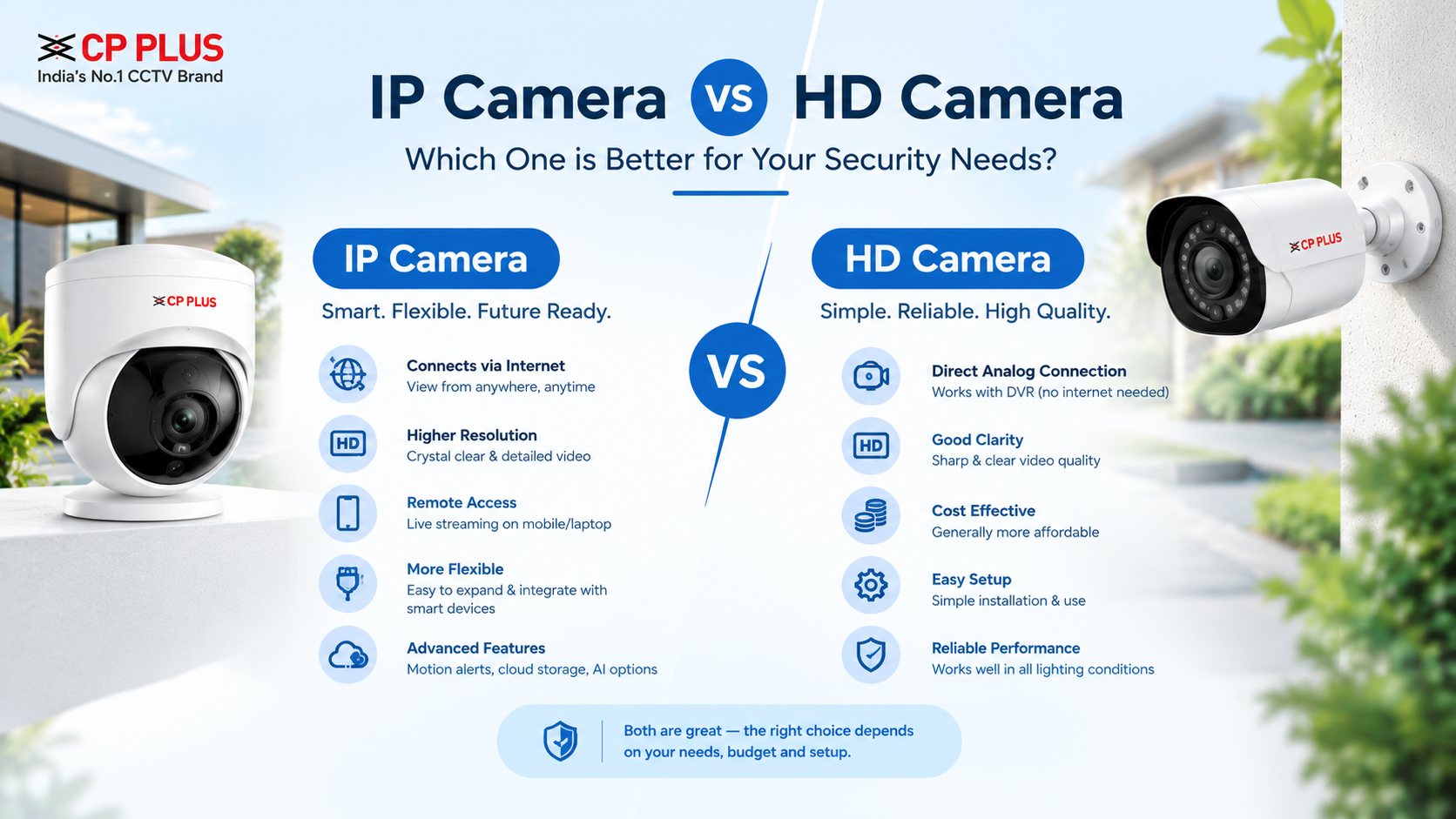
The main difference between an IP camera and an HD CCTV camera is the technology used to transmit video.
An IP camera, also known as an Internet Protocol camera, sends digital video over a network. It can connect through Ethernet or, on supported models, Wi-Fi. Network cameras can work with compatible Network Video Recorders (NVRs) or other supported recording solutions.
An HD CCTV camera commonly refers to an HD analog camera that sends video through a compatible coaxial cable to a Digital Video Recorder (DVR). Technologies such as HD-TVI, HD-CVI and AHD are used in this category.
Both types can provide clear video footage. However, their compatibility, networking capabilities and installation requirements are different.
What Is an IP Camera in IP Camera vs HD Camera?
An IP camera captures video and transmits it as digital data over a network. Depending on the model, it may support Power over Ethernet (PoE), remote viewing, motion detection, built-in audio and other smart features.
Advantages of IP Cameras
- Support for high-resolution video, depending on the model.
- Network-based connectivity and flexible system design.
- PoE support on compatible cameras, allowing power and data over one Ethernet cable.
- Advanced analytics on selected models.
- Integration with compatible NVRs and network systems.
- Convenient remote monitoring when correctly configured.
Disadvantages of IP Cameras
- Some models and NVRs cost more than basic analog HD alternatives.
- Network configuration may require technical knowledge.
- Compatibility must be checked before mixing cameras and recording equipment.
- High-resolution or continuous recording may require more storage and network bandwidth.
IP cameras are suitable for homes and businesses that need network-based surveillance and may want to expand their system in the future.
What Is an HD Camera in IP Camera vs HD Camera?
An HD CCTV camera usually refers to a high-definition analog camera connected to a compatible DVR. These cameras are commonly installed in homes, shops, offices and other properties that use traditional wired CCTV systems.
Advantages of HD CCTV Cameras
- Suitable for many conventional CCTV installations.
- Can reuse compatible existing coaxial cabling in some upgrades.
- Available in different resolutions and camera designs.
- Can be an economical option for basic surveillance requirements.
- Works with a compatible DVR for local video recording.
Disadvantages of HD CCTV Cameras
- Requires a compatible DVR and appropriate cabling.
- Advanced network features depend on the camera and recording system.
- Future expansion may require additional cabling or equipment.
- Audio, smart detection and other functions are not available on every model.
An HD CCTV camera can be a practical choice if you already have a compatible DVR and want to upgrade your surveillance system without replacing all existing infrastructure.
IP Camera vs HD Camera: Key Differences
The following table summarises the main differences between these camera technologies.
| Feature | IP Camera | HD CCTV Camera |
|---|---|---|
| Video transmission | Digital network | Analog HD video over compatible cabling |
| Typical recorder | NVR | DVR |
| Connectivity | Ethernet or supported Wi-Fi | Usually coaxial video cabling |
| Power supply | PoE or separate power on supported models | Usually separate power or compatible power arrangement |
| Resolution | Varies by model; high-resolution options available | Varies by model; HD and higher-resolution options available |
| Smart features | Available on selected models | Depends on camera and recorder |
| Existing cabling | Depends on network infrastructure | May reuse compatible coaxial cabling |
| Remote viewing | Available with compatible setup | Available through compatible DVR and network setup |
| Installation | Network configuration may be required | Often straightforward for existing compatible systems |
| Best suited for | Network-based and expandable systems | Traditional wired CCTV installations |
Important: Neither camera type is automatically better in every situation. Compare the specifications of the exact camera models and their recording equipment before making a decision.
IP Camera vs HD Camera: Which Offers Better Image Quality?
Image quality is one of the most important factors when choosing a CCTV camera.
IP cameras are available in various resolutions, including 2MP, 4MP and higher. HD analog cameras also come in different resolutions, depending on the technology and model.
A higher-resolution camera can capture more detail under comparable conditions. However, actual image quality also depends on the lens, sensor, lighting, compression and installation position.
Choose an IP camera if you need a particular high-resolution model or network-based features. An HD camera may be sufficient for entrances, small rooms and general monitoring if its image quality meets your requirements.
IP Camera vs HD Camera: Installation and Cabling
Installation requirements can affect the total cost of your CCTV system.
IP Camera Installation
IP cameras connect to a compatible network. PoE cameras can receive power and transmit data through a single Ethernet cable when used with suitable PoE equipment.
A network-based installation is useful when you want to add compatible cameras or organise a larger surveillance system. However, network capacity, cable length and power requirements must be considered.
HD Camera Installation
HD analog cameras generally connect to a compatible DVR using coaxial video cabling, with an appropriate power arrangement.
If your property already has compatible coaxial cables, an HD camera upgrade may reduce installation work. Check the DVR’s supported camera technology and resolution before buying new cameras.
IP Camera vs HD Camera: Storage and Recording
Both systems can record video locally, but they normally use different recording equipment.
IP cameras: A compatible NVR records video from network cameras. Storage requirements depend on resolution, frame rate, compression, recording duration and the number of cameras.
HD cameras: A compatible DVR records footage from connected HD analog cameras. Storage depends on the same general factors, as well as the recorder’s supported recording settings.
For either system, calculate storage according to the number of cameras and how many days of footage you want to retain. Confirm the recorder’s supported hard-drive capacity before purchasing.
IP Camera vs HD Camera: Which Is More Affordable?
The total cost depends on more than the camera’s price.
An IP system may require network cabling, PoE equipment, an NVR and suitable storage. An HD system may require compatible coaxial cabling, power supplies, a DVR and storage.
If you already have a working HD CCTV installation, upgrading compatible cameras may be more economical. For a new installation, compare the complete cost of both options, including cameras, recorder, cables, storage and installation.
Prices vary by model, features, availability and installation requirements. Always confirm the current price before ordering.
IP Camera vs HD Camera: Which Is Better for Home Security?
For a new home surveillance system, an IP camera can be a good option if you want network connectivity, flexible expansion and advanced features available on selected models.
An HD camera may be more suitable if you need basic monitoring or want to upgrade an existing compatible DVR system.
Consider the following requirements before choosing:
- Apartment: Monitor the entrance, hallway and other permitted areas.
- Independent house: Cover the main gate, driveway and important access points.
- Small shop: Choose cameras based on entrance coverage and the level of detail needed.
- Office: Consider network connectivity, recording duration and access permissions.
- Large property: Plan camera placement, cable routing and storage before buying equipment.
Which CP Plus CCTV Camera Should You Choose?
CP Plus offers different CCTV products for different surveillance needs. Navdurga Computer can help you compare suitable CP Plus models based on your installation requirements.
CP Plus IP Network Camera
An IP network camera may suit a new installation where network connectivity, PoE support or selected smart features are important.
For example, the CP Plus CP-UNC-DA21PL3C-Y is a 2MP IP network dome camera with a built-in microphone. Its supplied specifications include a 3.6mm lens, 30-metre IR range and IP67 rating.
Check the exact model specifications and compatibility before installing it indoors or outdoors.
CP Plus HD CCTV Camera
A compatible CP Plus HD analog camera may be suitable for a traditional DVR-based installation. It can be considered when upgrading an existing system, provided the camera and DVR support the same technology and resolution.
Before buying, verify the exact model, recording compatibility, night vision range and any audio requirements.
Final Verdict: IP Camera vs HD Camera – Which Is Better?
The choice between IP Camera vs HD Camera depends on your security requirements, available infrastructure and budget.
Choose an IP camera if:
- You want network-based surveillance.
- You need features available on selected network models.
- You plan to expand your system with compatible IP cameras.
- You prefer PoE connectivity where supported.
Choose an HD CCTV camera if:
- You already have compatible coaxial cabling.
- You want to upgrade an existing DVR-based system.
- You need a practical solution for general monitoring.
- Your budget and installation requirements favour a compatible analog system.
Both options can provide reliable surveillance when selected, installed and configured correctly. Compare camera specifications, recording equipment and the total installation cost before deciding.
For help choosing a suitable CP Plus CCTV camera, contact Navdurga Computer to discuss your home or business security requirements.
Frequently Asked Questions
Is an IP camera better than an HD CCTV camera?
An IP camera can be better for network-based installations and selected advanced features. An HD camera may be a better fit for an existing compatible DVR system. The best option depends on your requirements.
Can an IP camera work with a DVR?
Some hybrid recorders support compatible IP cameras, but not every DVR does. Check the recorder’s supported camera types, channels and network specifications.
Can an HD CCTV camera connect to an NVR?
Traditional HD analog cameras generally connect to a compatible DVR rather than directly to an NVR. Special converters or hybrid systems may support particular arrangements, but compatibility must be confirmed.
Which camera is best for home security in India?
Both IP and HD CCTV cameras can work well. Choose based on image quality, night vision, installation, recording requirements and budget.
Do IP cameras require the internet to record?
Not necessarily. Many IP cameras can record to a compatible local NVR without an internet connection. Remote access and cloud features may require internet connectivity.
Which CCTV camera is easier to install?
An HD camera can be easier to install when compatible coaxial cabling and a DVR are already available. An IP camera can be straightforward with a suitable PoE setup, although network configuration may be required.
Are CP Plus IP cameras suitable for businesses?
Suitable CP Plus IP camera models can be used in shops, offices and other business environments. Choose a model based on the required resolution, lens, lighting conditions and recorder compatibility.
What should I check before buying a CCTV camera?
Check the resolution, lens, night vision, weather resistance, recorder compatibility, storage capacity, warranty and installation cost. For network cameras, also check connectivity and PoE requirements.
Official Website : https://cpplusworld.com/